
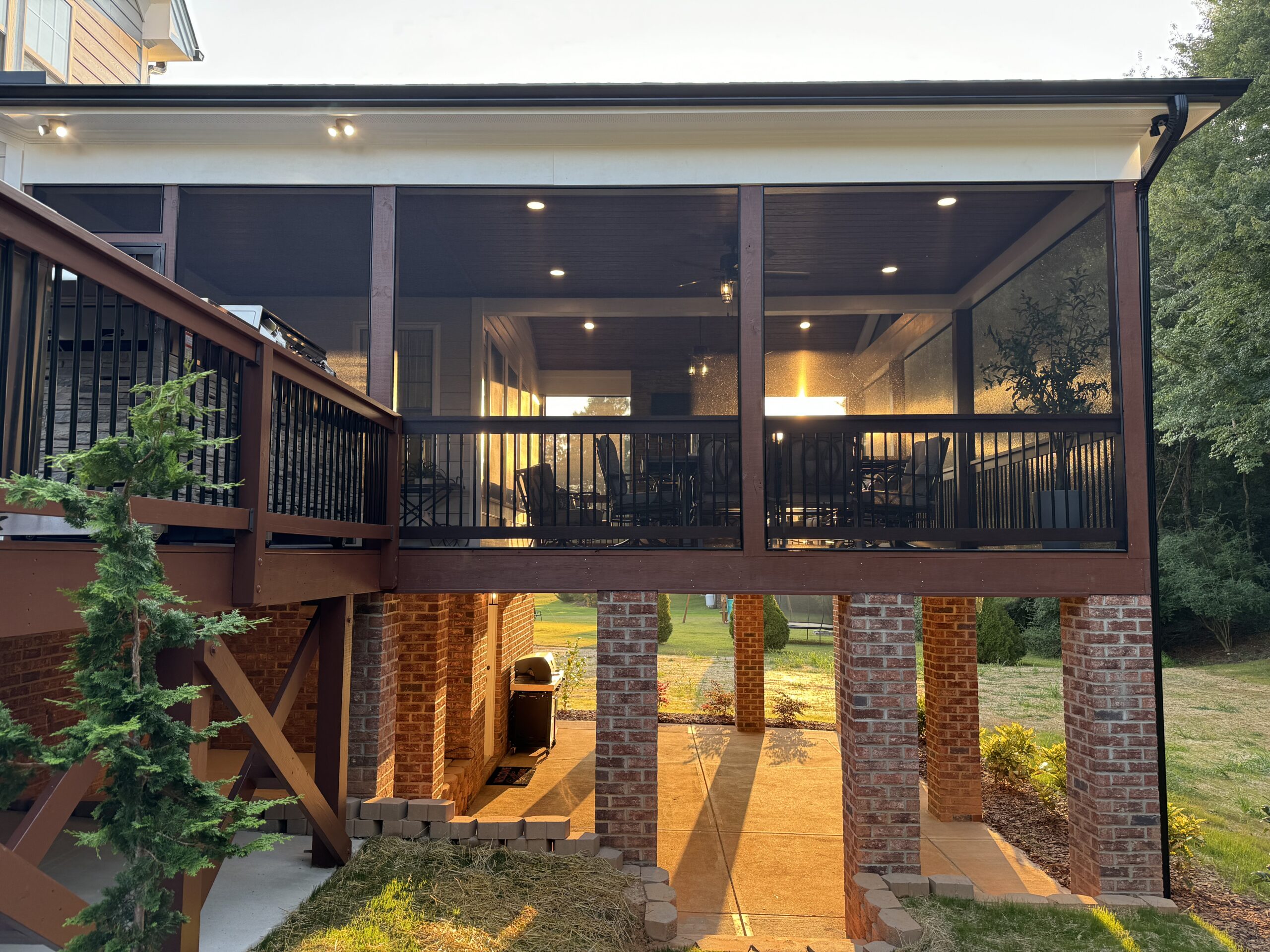
If you’re a homeowner in the Triangle thinking about adding a screened porch, you’re in good company. It’s one of the most popular home improvement projects in this part of North Carolina, and the first question many ask is what it’s going to cost.
This guide breaks down real 2026 screened porch pricing for the Raleigh, Cary, Apex, and greater Triangle area. We cover what drives costs up or down, what permits you’ll need by city, and how to make sure your investment pays off. All figures are 2026 estimates, and actual costs will vary based on your specific project, materials, and site conditions.
Pricing data in this guide comes from national home improvement databases, NC-specific project data, and our work as a residential contractor in the Cary area. Material pricing and labor availability shift regularly, so always get a detailed estimate for your specific project.
Why the Triangle Is Ideal for Screened Porch Living
The Raleigh-Cary area offers one of the longest outdoor seasons in the country. From roughly March through November, you get mild springs, warm summers, and comfortable fall evenings. That’s eight to nine months of usable porch time each year.
The flip side? Our warm, humid conditions also bring a serious mosquito population, aggressive pollen seasons (especially spring oak and pine), and afternoon summer thunderstorms that can shut down an outdoor dinner in minutes. North Carolina reported nearly 900 cases of tick- and mosquito-borne illnesses in 2023 alone.
A screened porch gives you the fresh air and the view without the bugs, the pollen film on everything, or the rush to get inside when rain rolls in. Add a ceiling fan for summer and a space heater or outdoor fireplace for cooler months, and you’ve got a space that works three seasons or more.
That’s a big part of why screened porches rank among the most requested outdoor projects from homeowners in Cary, Apex, Morrisville, Raleigh, and across Wake County. They also tend to hold strong resale value in this market, which we’ll cover below.
What Does a Screened Porch Cost in the Raleigh-Cary Area?
Costs depend heavily on whether you’re enclosing an existing structure or building from the ground up. Here’s how the numbers break down in 2026.
Screening an existing porch or deck
If you already have a covered porch or deck with a roof and solid structural posts, adding screens is the most affordable path. Nationally, this runs $2,000 to $5,800 for a typical project, or roughly $10 to $25 per square foot. The national average for a 200-square-foot enclosure is around $2,100.
Building a new screened porch from scratch
A ground-up build that includes foundation, framing, roofing, screening, and finishing is a much larger project. National estimates range from $10,000 to $35,000, or $50 to $175 per square foot.
In the Raleigh-Cary area, though, quality new screened porch builds can typically land between $25,000 and $60,000 for 150 to 300 square feet. That lines up with general home addition costs across the Triangle, which run $150 to $300 per square foot depending on complexity.
Why is local pricing higher than the national average? Strong demand for outdoor living spaces in the Triangle, NC building code requirements (more on those below), and the quality of labor and materials needed to build something that holds up through humid summers and occasional storms.
Cost by size for a new build in the Triangle:
12×12 (144 sq ft): $20,000 – $35,000. A cozy seating area or morning coffee spot.
14×16 (224 sq ft): $25,000 – $45,000. Room for a dining set and comfortable furniture.
16×20 (320 sq ft): $35,000 – $60,000+. Full outdoor living room with space to entertain.
These ranges assume a quality build with proper permitting and professional-grade materials. Budget builds on the low end of national estimates exist, but they tend to need repairs or replacement sooner, especially in NC’s humidity.
What Drives Screened Porch Costs Up or Down
Knowing where your money goes helps you make better decisions about where to invest and where to save.
Size
This is the single biggest cost factor. Every additional square foot adds materials, labor, and structural requirements. Wraparound designs can add $6,000 to $18,000 over a standard rectangular footprint because of extra framing and more complex roof work.
Structural Materials
Pressure-treated wood framing runs $10 to $15 per square foot and is the most budget-friendly option. It does require annual sealing to hold up in our humidity.
Composite decking and framing cost 10 to 20 percent more upfront but require virtually no maintenance. When you’re dealing with NC’s climate year after year, that trade-off is worth considering.
Roof Integration
How your porch roof ties into your existing home is one of the trickiest parts of the build. A simple shed-style roof that slopes away from the house is the most economical option. A gable roof that matches your home’s existing roofline looks better and adds height, but you’re looking at $70 to $155 per square foot for the full roof structure, supports, and shingles.
Foundation and Site Work
Uneven ground can add $500 to $5,000 for grading. Drainage issues can tack on another $200 to $2,000. If you’re building on an existing deck, the substructure may need reinforcement to support the added weight of a roof and screen system.
Electrical Work
Most homeowners want at least a ceiling fan and a couple of outlets. New circuits typically cost $250 to $700, with licensed electricians charging $50 to $130 per hour locally. Electrical work often requires its own separate permit.
Screen Door Style
A basic screen door averages around $300. That number climbs with custom sizing, sliding door systems, or retractable screen options. The cheapest approach is no exterior door at all (entering only through the home), but most homeowners prefer direct yard access.
Screen Material: What Are Your Options?
The screen material you choose affects visibility, durability, and long-term maintenance. Each option performs differently in our local conditions.
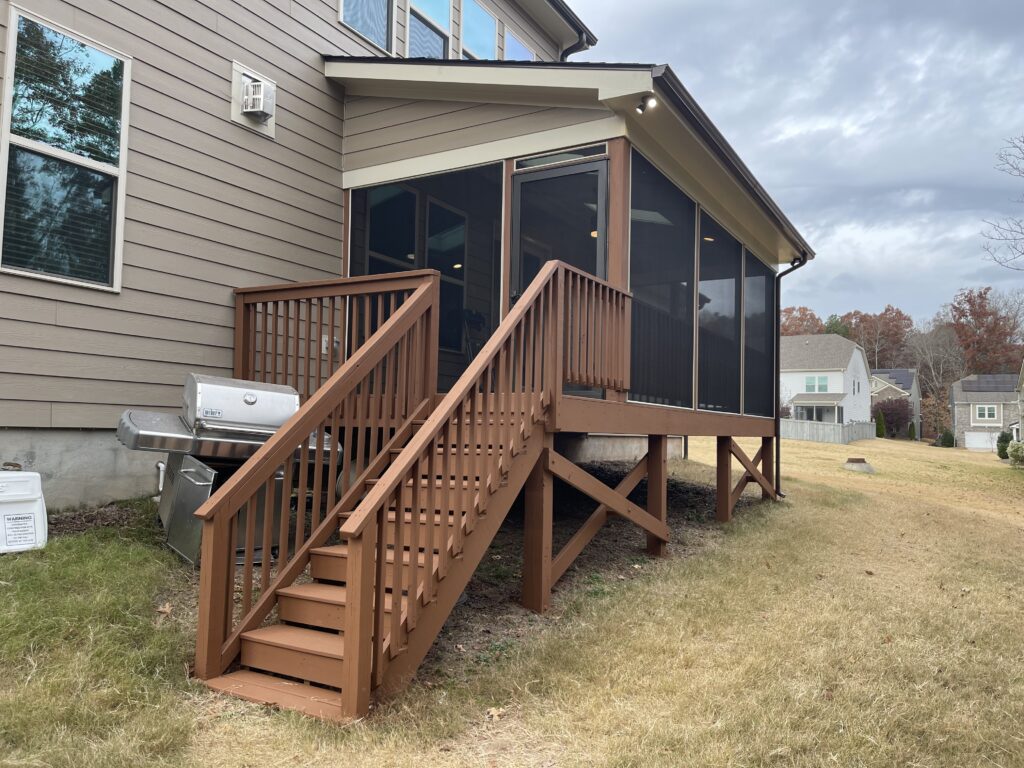
Fiberglass ($0.20 – $1.00 per sq ft)
The most widely used porch screen material. Fiberglass is affordable, flexible, and won’t rust or corrode, which matters in humid climates. It offers good visibility with minimal glare and is easy to repair.
The trade-off is strength. Fiberglass can tear more easily than metal screens, especially in homes with active kids or pets. Available in black, charcoal, and gray, with black producing the least glare.
Aluminum ($0.25 – $1.50 per sq ft)
Stronger and more rigid than fiberglass. Aluminum holds up well against wind and won’t sag over time. It provides excellent visibility but can crease during installation and dent on impact.
A solid pick for higher-traffic screen doors and for porches that face prevailing winds. Keep in mind that uncoated aluminum can corrode in consistently humid conditions.
Pet-Resistant Polyester ($0.50 – $1.50 per sq ft)
Vinyl-coated polyester screens handle the wear and tear from dogs, cats, and kids. They’re several times stronger than standard fiberglass and resist tears and stretching.
A popular approach for families: install a pet screen on the lower half of the porch walls and standard screen on the upper sections. You save on cost without giving up durability where it counts.
Solar Screen ($2 – $8 per sq ft)
If your porch faces west or south and bakes in the afternoon sun, solar screen is worth a look. These use a tighter, darker mesh that blocks UV rays and can reduce heat by up to 90 percent. They also offer more privacy from the outside.
The downsides are reduced outward visibility and higher cost. But for a sun-exposed porch in this part of North Carolina, the comfort difference can be dramatic.
Permits and Building Codes Across the Triangle
This is where most national cost guides fall short. They don’t cover what’s actually required in your city. Permits and code compliance are a real part of the process and the budget, and the requirements vary by municipality.
Raleigh
A building permit is required for any screened porch regardless of height, since it’s classified as a structural addition. You’ll need to submit a completed application through the City of Raleigh or Wake County Permit Portal, a site plan (certified survey), building plans meeting NC Residential Code Appendix M, and elevation drawings.
Raleigh also enforces impervious surface limits across five zoning districts, ranging from 20% to 65%. Where the porch sits on your lot matters. Properties in a historic district need a Certificate of Appropriateness from the Raleigh Historic Development Commission before the building permit application can even be submitted. Properties with septic systems require separate approval from Wake County Environmental Services.
Cary
Building permits are required, with local regulations covering setbacks, height, and size. Inspections happen at multiple construction stages. The standard review cycle runs about seven business days, though you can request a faster SPOT review. If construction falls within five feet of a setback, easement, or buffer, an as-built survey is required.
Apex
Permits are required with setback, height, and size restrictions enforced through local zoning. Inspections are required during the construction process, consistent with Wake County standards.
Durham, Garner, Clayton, and Fuquay-Varina
All require building permits with compliance to local zoning ordinances for placement, size, and structural requirements. Each town has its own planning department handling reviews and inspections.
Key NC-wide requirements:
All screened porch plans must meet the 2018 North Carolina Residential Code Appendix M. Any project where construction costs exceed $40,000 must be performed by a licensed North Carolina general contractor. Permits typically cost $400 to $800 depending on the municipality, and you should budget around $1,000 for surveying services.
A good screen porch contractor in the Triangle handles all of this for you: permit applications, plan submissions, inspection scheduling, and code compliance. If a contractor you’re talking to doesn’t bring up permits, consider that a red flag.
Is a Screened Porch a Good Investment?
Short answer: Yes, especially in this market.
Industry data consistently shows screened porches returning 70 to 84 percent of their cost at resale. The strongest returns show up in warm climates where outdoor living is a priority for buyers. That describes the Triangle pretty well.
A few things that affect your return:
Usable space matters more than premium finishes. A standard pressure-treated porch around $35,000 tends to hit close to 75 percent ROI. A high-end build at $50,000 with premium finishes might only recover 50 percent. Buyers pay for square footage they can use, not necessarily for the most expensive materials.
The 200 to 300 square foot range offers the best balance. Large enough to furnish as a real room, but not so large that costs outpace the value added to your home.
Unpermitted work can hurt your home’s value. A screened porch built without proper permits may not count toward appraised square footage, and it can create complications at closing. Most homeowners’ insurance policies won’t cover unpermitted structures either.
Beyond the financial return, there’s the daily quality-of-life payoff. A screened porch extends your usable living space for most of the year, reduces the pull toward air conditioning on mild days, and creates a space that most families end up using far more than they expected.
Screened Porch vs. Conditioned Sunroom vs. 3-Season Sunroom
If you’re researching screened porches, you’ve probably seen conditioned sunrooms and 3-season sunrooms come up as alternatives. All three extend your living space, but they serve different needs and sit at different price points.
Screened porch ($25,000 – $60,000 locally for new builds)
Open-air feel with bug protection. No climate control, so it’s most comfortable spring through fall. Typically the most affordable option and the highest percentage ROI at 65 to 85 percent. A great fit if you want that outdoor connection without a major construction project.
3-Season sunroom ($30,000 – $50,000+)
Uses windows instead of screens (many homeowners choose Eze-Breeze vinyl panel systems) for better weather protection. Usable spring, summer, and fall with more protection from wind and rain. Panels open for airflow or close when conditions change.
Conditioned Sunroom ($40,000 – $80,000+)
Fully enclosed with glass, insulation, and HVAC. True year-round living space that adds conditioned square footage to your home’s appraisal. Higher cost but the most versatile option. In the Southeast, sunrooms deliver 50 to 70 percent ROI. Lower percentage than screened porches, but a higher dollar amount added to home value.
Many homeowners start with a screened porch and later convert to a 3-season or full sunroom. If that might be in your future, mention it during the design phase. Building the initial structure with conversion in mind can save real money down the road.
How to Choose the Right Screen Porch Contractor
The contractor you choose will shape the outcome more than almost any other decision. A quality screen porch contractor in the Raleigh-Cary area should check these boxes:
Licensed NC general contractor.
State law requires this for projects exceeding $40,000, and most quality screened porch builds will cross that threshold. You can verify a contractor’s license through the NC Licensing Board for General Contractors.
Local permit experience.
Every municipality in the Triangle has its own process, review timelines, and quirks. A contractor who regularly pulls permits in Cary, Raleigh, or Apex will move through the process more efficiently. A good question to ask: “Do you handle permitting, and have you worked in [your town] before?”
Portfolio of local work.
Ask to see completed projects, ideally in your area. Photos and references from homeowners in similar neighborhoods tell you more than any sales pitch.
Transparent pricing and timeline.
A detailed written estimate should break down materials, labor, permits, and any allowances for site conditions. Be cautious of vague quotes or numbers that feel unusually low. Cutting corners on structural work or permitting can cost far more in the long run.
Clear communication.
Your screened porch project will take anywhere from one to eight weeks depending on complexity. You want a contractor who keeps you informed on progress, changes, and inspection results without you having to chase updates.
Questions to ask during your consultation:
• What materials do you recommend for our climate, and why?
• How will the porch roof integrate with our existing roofline?
• What’s included in your estimate vs. what might be additional?
• Do you handle electrical, or is that subcontracted separately?
• What’s the permit timeline in our specific municipality?
• Can you share references from recent porch or addition projects?
Ready to Talk About Your Project?
At AG Construction Management, we design and build screened porches, sunrooms, and home additions for homeowners across Cary, Raleigh, Apex, Morrisville, Durham, and the surrounding Triangle area. We handle everything from initial design through permitting, construction, and final inspection.
If you’re thinking about adding a screened porch to your home, we’d be happy to walk through your project. Reach out for a consultation and estimate.
Phone: (984) 222-9198
Email: Info@ag-cm.com
Office: 5000 Centregreen Way #500, Cary, NC 27513

Sunroom Cost In 2026: $40K–$80K Typical Range (Cary NC GC)
[…] want a bug-free outdoor space and are not planning to use it in January. See AG-CM’s screened porch cost guide for full pricing […]